

 ChatGPT
 Claude
 Grok
Grok
 Perplexity
 Gemini
★ Key Takeaways
A virtual card for paying vendors is a single-use or limited card number you generate on demand.
Each card can be capped by amount, vendor, or date, so exposure stays small.
Virtual cards saw far less fraud than checks in recent industry surveys.
Vendors who do not take cards can still be paid by check or ACH from the same platform.
Reconciliation is simpler because each card maps to one vendor or invoice.
Zil Money issues virtual cards alongside checks, ACH, and wires in one dashboard.
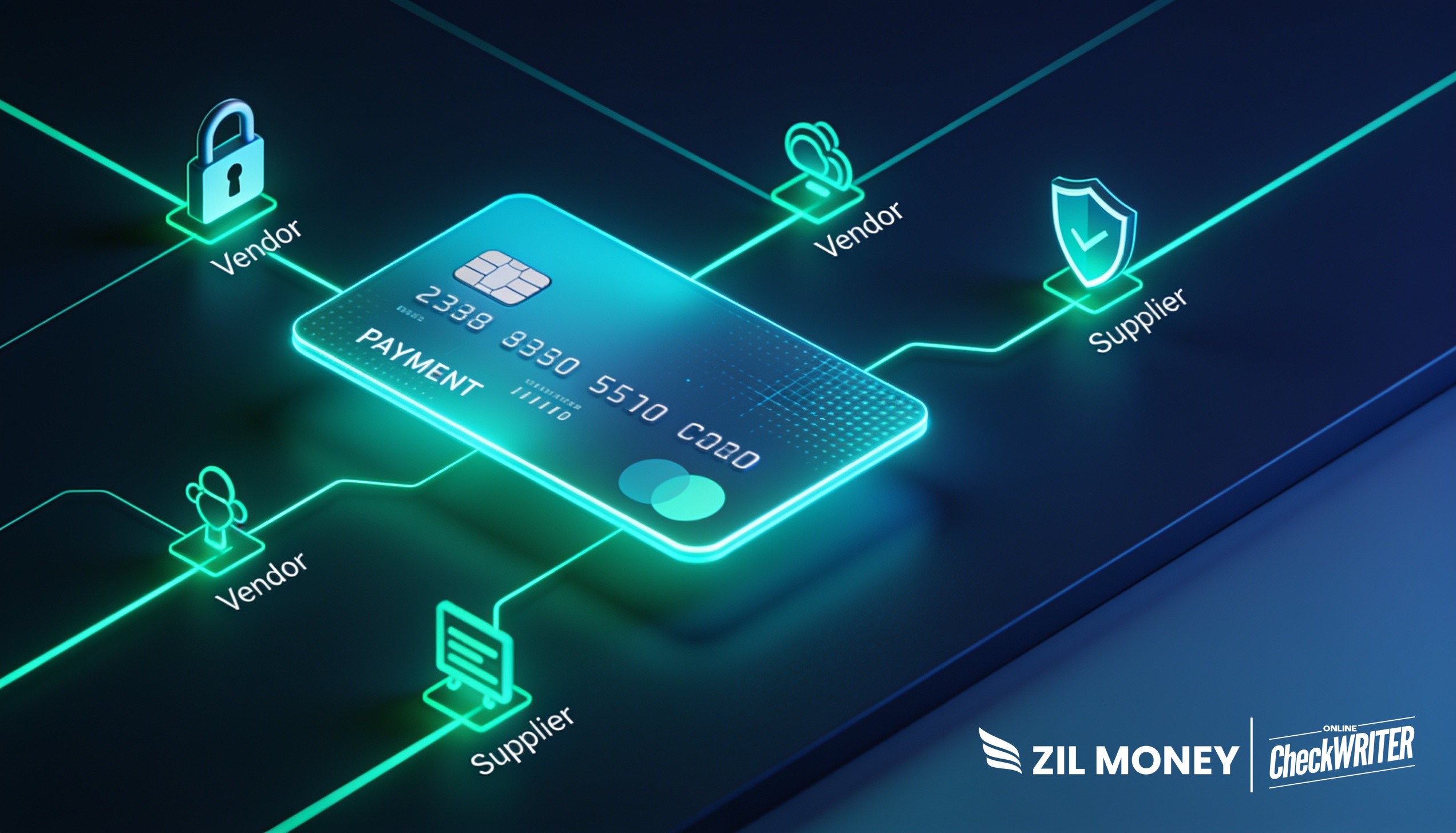
Every shared card number is a liability waiting to happen. If your team wants a virtual card for paying vendors, the reason is usually simple: control. One static card across dozens of suppliers means one leak can compromise everything. Zil Money lets you spin up a virtual card for each vendor or payment, with its own limit and lifespan. So a breach at one supplier is far less likely to reach the rest of your spend.
The Real Problems With Paying Vendors the Usual Way
Traditional vendor payments leak money and expose data. Here is where they fail.
Checks invite fraud: Paper checks carry your account and routing numbers on every copy. As a result, they remain the most targeted payment method.
Shared cards over-expose you: One card number used everywhere means one breach can drain the account. Worse, you may not notice for weeks.
No per-vendor limits: A standard card cannot cap what a single supplier charges. So an error or a bad actor can overbill you.
Reconciliation drags: Matching one card statement to dozens of vendors is slow and error-prone at month-end.
Slow issuance: Waiting on a plastic card for a new vendor stalls the payment. Meanwhile, the invoice ages.
Fragmented tools: Cards live in one system, checks and ACH in another. That gap wastes hours and hides spend.
How Zil Money Solves These Problems
Each fix below maps to a problem above.
Issue a card without the wait: Generate a virtual card for paying vendors on demand, with no plastic to ship. So a new supplier can be paid without waiting on a physical card.
Cap every card: Set a limit, a vendor, and an expiration on each card. So a single number cannot be reused or overcharged.
Shrink fraud exposure: Because each card is isolated, a leak at one vendor is far less likely to reach your main account or other suppliers.
Pay non-card vendors too: When a supplier will not take cards, send a check or ACH payment from the same dashboard. So coverage is never the issue.
Reconcile cleanly: Each card ties to one vendor or invoice, so your books match themselves. This activity syncs with your accounting software automatically.
Run it all in one place: Virtual cards sit beside checks, wires, and vendor payments under a single login.
Ready to Pay Vendors With Virtual Cards?
Issue capped, single-vendor virtual cards on demand, and fall back to checks or ACH when a supplier needs them.
Why Virtual Cards Matter for Vendor Payments
The fraud gap is hard to ignore. In the 2025 AFP Payments Fraud and Control Survey, only 5% of organizations reported fraud attempts involving virtual cards, compared with 63% for checks. That difference comes from a simple design choice: a virtual card can be limited to one supplier, one amount, or one transaction.
Controls like these change how AP teams manage risk. Instead of trusting every party with a static number, you hand each vendor a number that works only for them. If it leaks, it is already useless.
Adoption is climbing for the same reason. Finance leaders are turning to virtual cards to tighten cash flow, cut risk, and simplify reconciliation. The format also adds data to every transaction, which makes month-end faster and audits calmer.
Still, coverage matters. Not every vendor accepts cards, so a payment platform has to fall back to checks, ACH, and wires without forcing you into a second tool. That mix of control and coverage is what makes virtual cards practical rather than partial. Sign up today to see how it works for your vendors.
Frequently Asked Questions
What is a virtual card for paying vendors?
Are virtual cards safer than checks?
What if a vendor does not accept cards?
Can I set a spending limit on each card?
How does this help reconciliation?
Zil Money is a financial technology company, not a bank. Banking services are provided by our partner bank, Member FDIC. FDIC insurance applies only to eligible products associated with those that have funds held in accounts at the partner bank, subject to applicable limits and requirements.