

 ChatGPT
 Claude
 Grok
Grok
 Perplexity
 Gemini
Quick answer: For trucking companies, “credit card processing” usually means paying with a card, not taking payments from customers. A carrier puts fuel and repair costs on a limited-use virtual card, or uses a card to cover a load’s cost while the shipper’s invoice is still unpaid, instead of selling that invoice to a factoring company. This saves you money if you pay the card bill in full each month. If you don’t, the card’s interest rate takes over, and it can end up costing more than factoring would have.
Key Takeaways
What Does Credit Card Processing Mean for a Trucking Company?
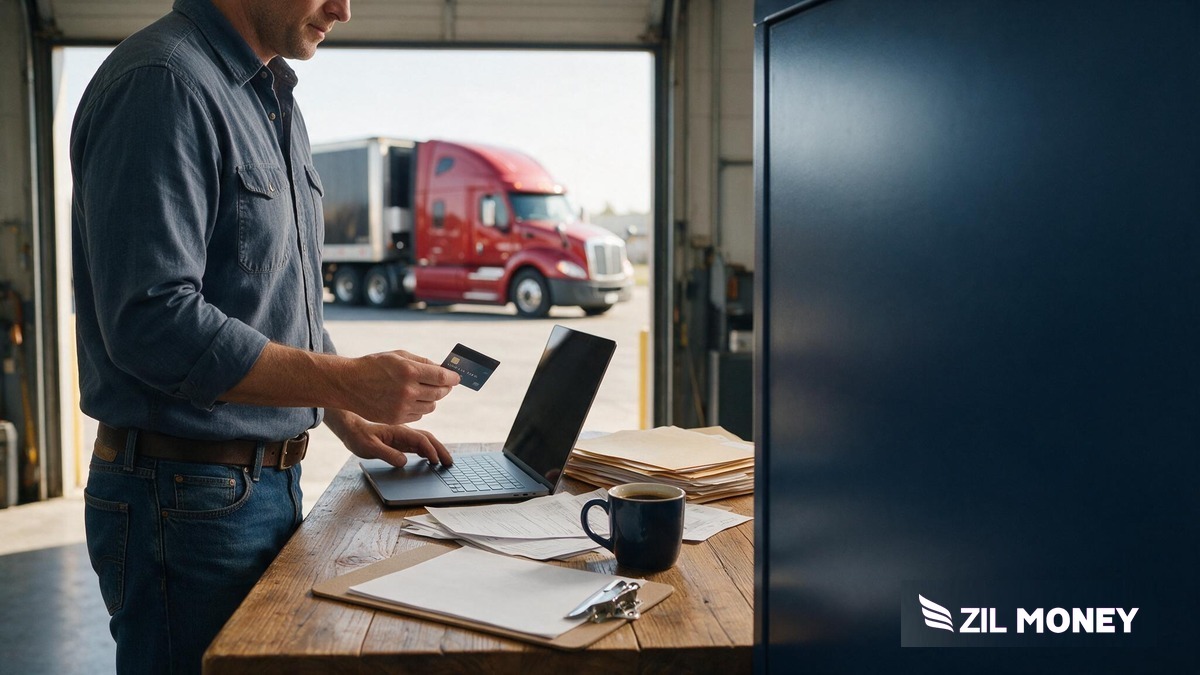
Search this phrase and most results talk about taking a customer’s card: point-of-sale machines, interchange rates, and so on. For a carrier or owner-operator, that’s rarely what you need. What matters day to day is paying with a card. That means putting fuel, tolls, and small repairs on a card instead of taking a cash advance. It also means using a card to cover a load’s cost, driver pay, or a repair bill before the shipper’s invoice clears, as a bridge instead of selling that invoice to a factor. If getting brokers and shippers to pay you faster is your bigger problem, read our companion guide: 7 Ways Better Payment Processing for Freight Carriers Fixes Slow Cash Flow.
Where a Credit Card Beats Factoring, and Where It Doesn’t
Freight factoring means you sell your unpaid shipper invoice to a factoring company for an early payout. A credit card works differently. You cover the load’s cost today, then pay off the card once the shipper’s invoice clears on its normal schedule. Zil Money’s credit card payment option costs about 2.9% per transaction. Factoring usually costs 3% to 5% of the load. On paper, 2.9% looks cheaper. But that’s only true if you pay your card bill in full by the due date. Miss that date, and the balance starts collecting interest at your card’s regular rate, set by your card issuer. The Federal Reserve’s most recent report puts the average rate on card balances above 22%. That’s well past both the 2.9% fee and the factoring discount it was supposed to beat.
Here’s an example. A five-truck company runs steady loads for a broker on net-45 terms. Paying $40,000 a month in fuel and repairs by card costs about $1,160 at 2.9%, as long as the bill gets paid off. Carry that same balance for even one month at 22% interest instead, and you add about $730 in interest on top, for a total cost of about $1,890, or roughly 4.7%. That lands inside the 3 to 5 percent factoring range, so a single missed due date is enough to erase the fee advantage the card was supposed to have. Run this same math with your own numbers, and check it again whenever your loads or payment terms change.
Two Different Clocks: Zil Money’s Payment Window and Your Card’s Billing Cycle
Zil Money’s credit card option gives you 30 to 45 days between paying a bill and settling up on your card. That window is real, and it’s useful, but don’t confuse it with your card’s grace period. The grace period is the interest-free window between your statement closing and your payment due date. It’s usually shorter than 30 to 45 days, and your card agreement sets that date, not Zil Money and not your shipper.
The Consumer Financial Protection Bureau explains how a card’s grace period works. Miss your due date once, and you can lose that grace period the next cycle too. Keep track of both dates separately. Mixing up Zil Money’s 30-45 day window with your card’s due date is exactly how a carrier ends up owing interest they didn’t expect.
Virtual Fuel Cards: Keeping Driver Spend Under Control
A virtual fuel card goes to one driver and only works for fuel, unlike a shared company card that works anywhere. Dispatch sets a spending limit on each card, watches transactions as they happen, and can freeze a card from the dashboard if a truck sits idle too long or a card number looks stolen. That’s faster than calling a bank’s fraud line and waiting on hold while your driver is stuck at the pump. Fuel spending also rolls up by truck, driver, or route. So if one route is quietly burning more fuel than it should, you’ll see it early instead of after it becomes a habit.
Maintenance, Repairs, and What Rewards Actually Add Up To
Fuel isn’t the only cost you can put on a card. Maintenance, tire service, repairs, and trailer rental are all costs you’re paying anyway. A rewards business card turns some of that spending into cash back, usually 1% to 2% on fuel or travel categories. Rewards rates are set by your card issuer and vary, so check your own card’s terms before you count on a number. On $3,000 to $4,000 a month in fuel and repairs, even a small rewards rate adds up over a year. That’s the smaller win, though. The bigger one is the float: your cash stays in your account longer while the truck and the paperwork catch up.
How Do You Set Up Credit Card Processing for a Trucking Operation?
- Connect your business bank account and load your operating balance into your Zil Money wallet.
- Turn on credit card payments for fuel, vendor bills, and any load cost you want to cover until the shipper pays.
- Give each driver a virtual fuel card with a spending limit, set to fuel-only or a specific merchant.
- Decide when to use the card instead of your wallet balance. For example: only for loads where the shipper’s payment terms run past 30 days.
- Connect your TMS and accounting software so every card charge posts against the right load and account automatically.
Keep Trucks Loaded, Not Waiting on Cash
Issue driver fuel cards, cover a load’s cost with a credit card, and sync it all to your TMS and accounting software from one dashboard.
Frequently Asked Questions
What’s the real difference between the card’s 30-45 day window and my card’s due date?
Zil Money’s 30-45 day window covers the time between paying a bill and settling your card. Your card’s due date and grace period are set separately, by your card issuer’s agreement. Think of them as two different clocks, not one.
Can I restrict a driver’s virtual card to fuel purchases only?
Yes. A virtual fuel card can be restricted to fuel purchases or a specific merchant type, and dispatch can freeze it from the dashboard at any time.
What actually happens if the balance revolves instead of getting paid off?
Interest starts building on the unpaid balance, at your card’s regular rate. The Federal Reserve says the average rate on accounts carrying a balance is above 22%, and business cards often run the same or higher. At that point, the interest rate, not the 2.9% fee, decides whether the card was actually cheaper than factoring.
Does this connect to the TMS and load board software we already use?
Yes. Zil Money’s logistics payment tools are built to connect with the TMS, load board, and accounting software many carriers already use, so charges post against the right load without manual re-entry.
Is a 3 to 5 percent factoring discount typical for every carrier?
It’s a common range, but factoring companies price based on risk. A new carrier or unpredictable freight can land at the high end or above it. A carrier with steady loads and a good factoring relationship can land lower. Get a real quote before you assume either number.
Is this only for large fleets, or does it work for one truck?
A solo owner-operator uses the same wallet and virtual card tools as a large fleet. If you run one truck with unpredictable pay cycles, be extra careful about carrying a balance. You have less cash flow to absorb an interest hit.
Can I still pay drivers and vendors by ACH or wire alongside the card?
Yes. ACH and wire transfers are both available alongside the credit card option and virtual fuel cards, so a recurring vendor bill or a one-off equipment purchase doesn’t need a separate tool.
What happens to owner-operator 1099s if I pay them through this system?
1099 forms for owner-operators are built in. Your year-end forms come from the same payment records as your regular settlements, so you don’t have to rebuild them separately.
What happens if a card charge is wrong or fraudulent?
Flag it from your dashboard or contact support, and freeze the card if needed while you sort it out. From there, your card issuer’s normal dispute process applies, the same as it would for any other business card charge.
Use the card where it earns its 2.9%: driver fuel spend you want to watch closely, and loads you need to float until the shipper pays. Payroll, rent, and other recurring bills still run better through ACH or your wallet balance. Run the factoring-versus-card math again next quarter, not just once. A five-truck fleet on steady lanes and a solo owner-operator hauling spot loads will land on different answers. And your own answer will change as your loads change.
Zil Money, is a financial technology company, not a bank. Banking and money movement services are provided through partner financial institutions and licensed service providers. FDIC insurance coverage applies only to eligible deposit products and accounts, and is subject to applicable terms, conditions, limitations, and requirements. Additional information regarding partner institutions, products, and services is available in the applicable terms and agreements.